Genial Care — A family app that made autism care lighter, clearer and closer
Design Lead, Founding Team · 2020–2023 · 0→1 · Consumer mobile app
Impact at a glance:
NPS 94
87% adherence to children's development programs
24/7 family support

The problem
The app's main users were mothers of autistic children. Their daily life is exhausting: accepting the diagnosis, burnout, and a child going through frequent dysregulation and crises.
Therapy happens in the clinic, but most of a child's life happens at home.
Families had no visibility into what was being worked on, no tools to support it, and clinical language often made them feel more distant and less capable.

Strategy
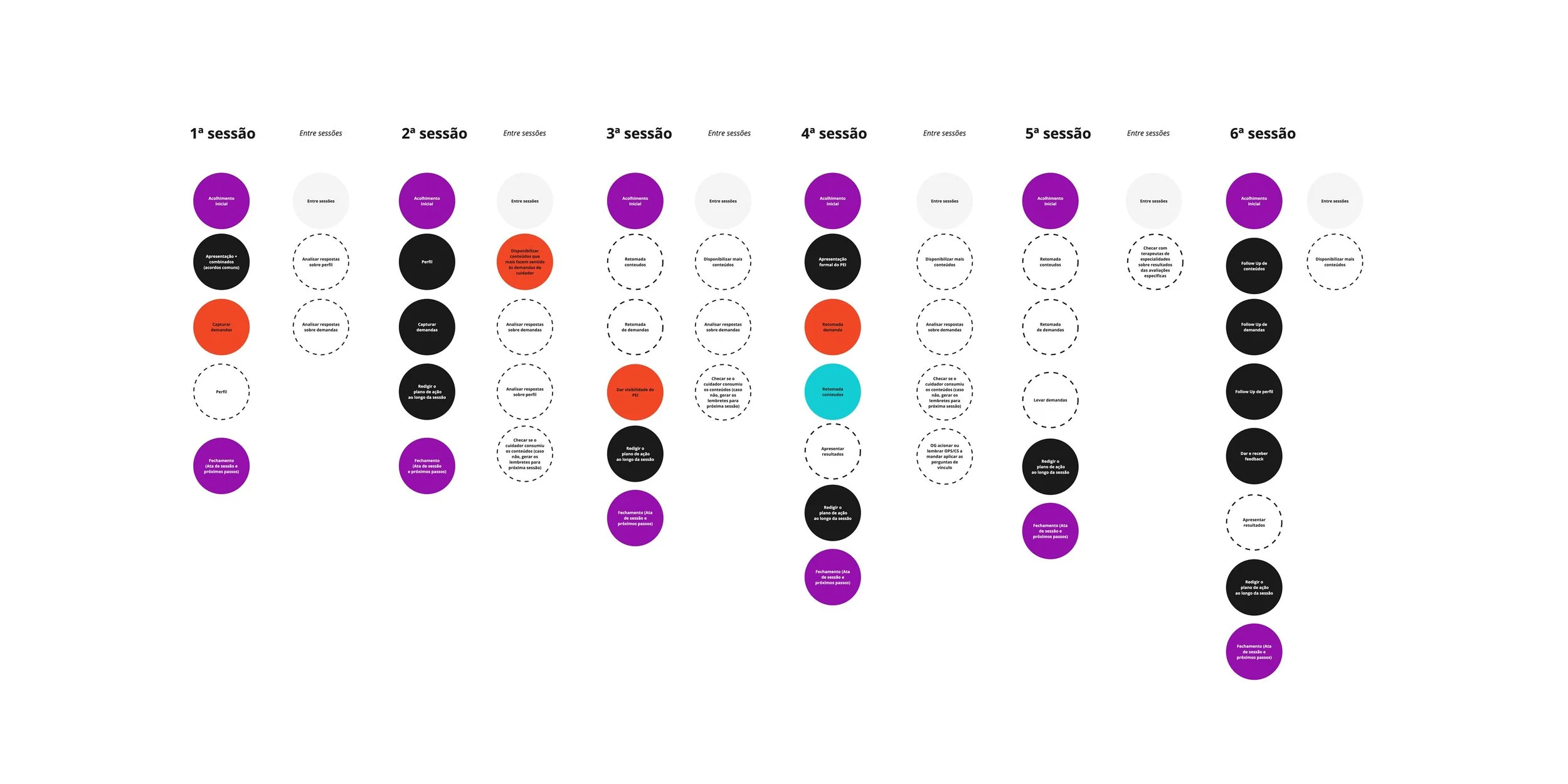
The guiding design principle was to reduce cognitive and emotional load. That meant three things:
Translating clinical data into plain-language progress.
Making parents an active part of the child's care network, through parent training, instead of passive spectators.
A deliberately friendly, illustrated and didactic interface. For an audience under constant stress, that visual tone was a product decision, not decoration.
What I built
The child's IEP in plain language. Built on the same data model as the clinical platform, with session records from in-person therapies and each skill's progress shown in percentages.
Telemedicine and chat 24/7 support. Families could reach the care team at any time.
Personalized content. Exclusive material on autism, behavior analysis, therapies and practical support tools, matched to each family's moment.
AI to consolidate the experience. It brought records, progress and content together into a single, understandable view of the child's journey.

What we delivery

Prototyping
We learned that families life is so struggling many times each day. It is not easy to deal with child crisis. Even that moment when a mom could be not prepared to achieve your own emotional regulation in crisis moment in each event is not a garantee.
So, I invested a lot in friendly user flow with great microcopies, illustrations and educational content. Our focus was to create and design a warmy feeling to users. Helping them to remember and feel great in a few minutes.

Impact
The app reached NPS 94 and 87% adherence to the children's development programs, which is rare engagement for a care journey that lasts years.
Qualitatively, families reported feeling more confident and less alone, and better able to support their children and themselves.
The app became the bridge between the clinic and the home, and a core part of why families stayed in the program.
Clinical outcomes
Clinicals had to reinforce the importance of the knowledge and they made follow up in each 3 week. After 6 month cycle, we analyse all data and understand the family evolution applying a clinical protocol that calls HSQ (Home Situation Questionaire) to measure their data about each aspect of life and see results about (i) core skills (dressing, sleeping, rising, eating, walking, hygiene, activities) and (ii) disruptive behaviors.
Teaching core skills to autism families
Tracking progress and evolution
Beyond the library and content approach, telemedicine and chat 24/7, each clinical session was executed by an therapist, and they record and write like a tweet how was the response of child for the parents and register the number of attempts and response in our platform.
This experience works like a relief for parents that want to know how thing are going per skill, increasing deeply the understanding about child response and behavior that we are building together.
Furthermore, they could know the total number of hours and sessions, skills and child progress per session. That was the best way that we find to help parents to follow the our individualized teaching program for both: parents and child.
